RickyCasino payment methods Australia
 Available in US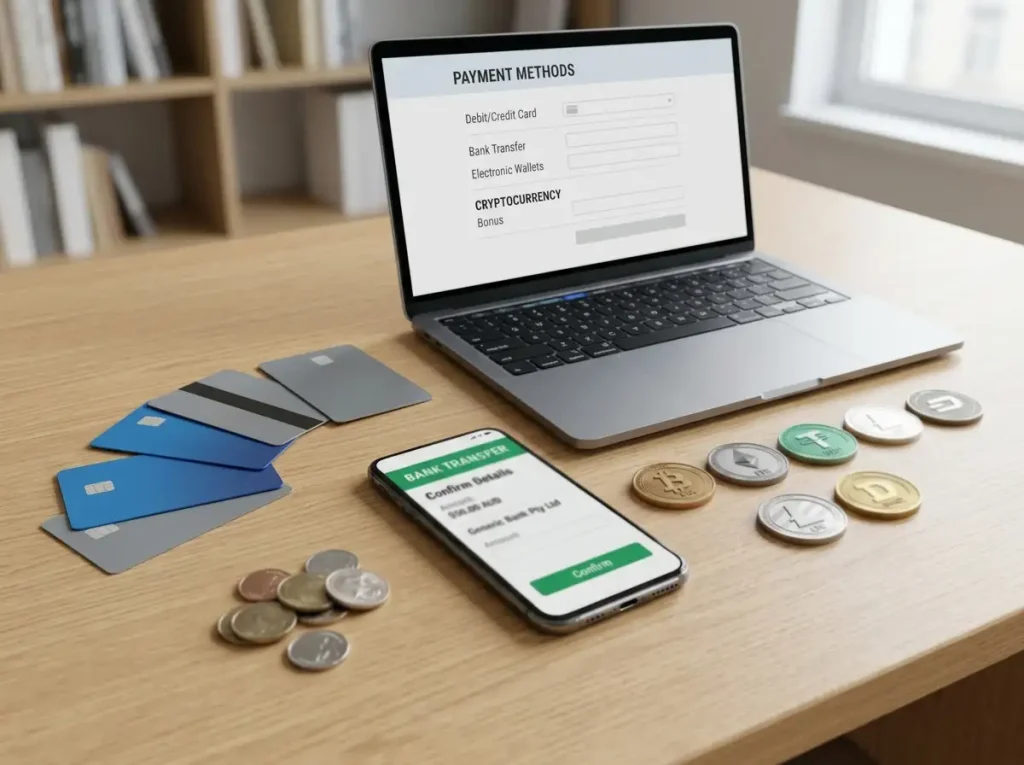
RickyCasino uses a hybrid cashier that combines fiat rails with crypto account currencies. The core payment set includes Visa, Mastercard, e-wallets and bank transfers, while the site’s payment information also names Neteller, Skrill and Paysafecard as common examples. BTC, ETH, USDT, LTC and DOG sit alongside AUD, EUR, USD, CAD, NZD and NOK as supported account or payment currencies. The useful way to read that breadth is method by method: the rail, currency, conversion step and provider fee can all change what actually leaves or reaches your balance.
Table of Contents
- The cashier mixes fiat rails with five crypto currencies
- Deposits and withdrawals use different rule sets
- Crypto deposits add price movement before casino play begins
- Bank and provider charges can sit outside the cashier amount
- The general deposit floor is EUR 20 equivalent
- Common payment questions
- RickyCasino payment decisions come down to method-level costs
The cashier mixes fiat rails with five crypto currencies
RickyCasino lists AUD as one of its account currencies, which removes the need to think in euros or US dollars for every balance entry. It also supports EUR, USD, CAD, NZD and NOK on the fiat side, plus BTC, ETH, USDT, LTC and DOG on the crypto side. That creates several different ways to fund an account, but it does not make the methods operationally identical.
Cards are familiar because the amount starts in a bank-linked fiat currency. E-wallets place another provider between the bank and the casino. Bank transfers can involve intermediary institutions. Crypto adds a separate asset-price and transfer-cost layer before the casino balance is reached. The method that looks simplest on a cashier menu can therefore have a different total cost from another method even when the nominal deposit amount is the same.
| Payment area | RickyCasino detail | Practical reading |
|---|---|---|
| Account currencies | AUD, EUR, USD, CAD, NZD, NOK | Choose a balance currency that reduces unnecessary conversion between your funding source and casino account. |
| Cards | Visa and Mastercard | Card issuer rules and foreign-currency handling can affect the final bank statement amount. |
| E-wallet examples | Neteller, Skrill, Paysafecard | Cashier access can vary by country and method, so the live method list controls what can actually be selected. |
| Bank transfer | Bank-transfer funding is supported | Bank and intermediary charges can sit outside the amount shown by the casino. |
| Crypto currencies | BTC, ETH, USDT, LTC, DOG | Crypto adds exchange-rate movement and blockchain transfer costs to the funding decision. |
| Crypto conversion | Coinbase Converter rates are used at transaction time under the terms | The crypto quantity and its AUD-equivalent value can change with the market price at the moment of conversion. |
Country and cashier rules still matter within those categories. A method named on a general payments page is best understood as part of the supported payment set, while the live cashier determines whether that rail is selectable for a particular account and what method-specific limit is displayed.
- Match the casino account currency to the currency of the funding source where possible.
- Check whether a card or wallet provider applies its own conversion or service charge.
- For crypto, check the asset and transaction value separately instead of treating the coin amount as a fixed AUD value.
- Keep deposit and withdrawal routes separate in your planning because payout rules can differ from funding rules.
Deposits and withdrawals use different rule sets
A method that can receive a deposit does not automatically carry the same conditions when money moves back out. RickyCasino’s withdrawal terms have their own minimums, rolling limits, processing language, verification holds and card-return mechanics. Repeating all of those details on the funding page would blur the distinction, so the withdrawal guide keeps the cashout rules in one place.
Two points are still useful before choosing a deposit method. First, RickyCasino requires deposited funds to be wagered three times before withdrawal. Second, card withdrawals can be returned to the original card up to the amount of net deposits, with excess paid by another method. Those rules mean the deposit route can influence the later payment path even though deposit and withdrawal limits are separate.
Verification is another bridge between the two stages. Identity, address and payment-method documents can be requested before a withdrawal, and a payout can remain pending while those checks are completed. If the payment route uses a card, wallet or account that cannot be matched cleanly to the account holder, the administrative friction can be greater. The account verification guide explains the document categories and the BTC-specific identity requirement in more detail.
- Choose the deposit rail and account currency before moving funds.
- Keep proof of the funding method, especially when a later payout may need to return to the same route.
- Complete any account verification request through the official account channel.
- Read the withdrawal rules separately before assuming a deposit method will produce the same cashout path.
This separation is useful because a cashier button answers “how can I fund the balance?” while the withdrawal terms answer “under what rules can money leave the balance?” Treating those as two steps avoids surprises from limits or verification that only appear at the cashout stage.
Crypto deposits add price movement before casino play begins
BTC, ETH, USDT, LTC and DOG are listed as supported crypto account or payment currencies. RickyCasino’s terms say crypto transactions use Coinbase Converter rates at the time of the transaction. That means the casino-side conversion is tied to a market rate at a specific moment rather than a fixed AUD figure that remains constant between funding and withdrawal.
For BTC, ETH, LTC and DOG, the AUD-equivalent value can move while the asset is held. USDT is designed to track the US dollar, but the casino still treats the transaction through its crypto conversion process and the blockchain transfer remains a separate event. None of that makes a future rate predictable. It simply adds an extra variable that does not exist when the same starting amount moves through a straightforward AUD card payment.
Network costs also deserve separate treatment. The terms identify supported crypto currencies, but they do not provide a casino-specific schedule of blockchain network fees for each coin. The cost of moving crypto can depend on the wallet, network conditions and the route used by the sender or recipient. Do not treat a generic network fee estimate as a RickyCasino tariff.
A simple way to think about the exposure is to split the transaction into three numbers: the AUD-equivalent value before sending, the value after market movement, and any transfer cost paid outside the casino balance. The crypto value check on the home page uses exactly that scenario logic. It does not forecast prices; it shows how a reader-entered price move and transfer costs change the ending AUD-equivalent value.
Crypto transfers are also irreversible once settled on-chain. A wrong destination or incompatible transfer path can be much harder to reverse than a bank-card error. Check the address and supported asset carefully before confirming a transfer, and avoid sending on assumptions about networks that the cashier does not explicitly show.
Bank and provider charges can sit outside the cashier amount
RickyCasino’s terms place bank and payment-provider fees on the player. They also state that intermediary-bank charges can be as high as EUR 16. That figure is especially relevant to bank-transfer routes because the amount leaving one bank is not always the amount that arrives after correspondent or intermediary deductions.
The terms also allow the casino to apply a processing fee or refuse a withdrawal when the deposit-wagering requirement has not been met. The detailed cashout mechanics belong on the withdrawal page, but the payment lesson starts earlier: the nominal cashier amount is not always the complete cost of the transaction.
Currency conversion creates a similar gap. If an Australian reader funds an AUD account directly in AUD, there may be no casino-side currency conversion at the account level. If the funding source is in another fiat currency, the card issuer, wallet or bank can apply its own exchange rate. If the source is crypto, the terms use the Coinbase Converter rate at transaction time. These are different mechanisms and should be checked separately.
- Casino amount: the deposit value entered in the cashier.
- Provider amount: any bank, card or wallet fee outside the casino.
- Conversion amount: any exchange-rate effect when the funding currency differs from the account balance.
- Crypto transfer amount: any blockchain or wallet cost that reduces the value arriving or leaving.
When comparing methods, add those layers rather than looking only at the advertised deposit amount. A method with no visible casino fee can still produce an external bank, wallet or network cost.
The general deposit floor is EUR 20 equivalent
RickyCasino’s terms set a general minimum deposit of EUR 20 or the equivalent, while the exact limit for a specific payment method is shown in the cashier. That makes EUR 20 equivalent a useful terms-level baseline, but not a guarantee that every method will display exactly that floor for an Australian-facing account.
The difference comes from context. Payment rails can apply their own minimums, and the casino’s current promotional conditions can use a different qualifying amount from the general deposit rule. The practical number for a real transaction is therefore the method-specific amount shown before confirmation, with the terms baseline used as the broader account rule.
Before funding, check three fields in order: the selected account currency, the payment method, and the final amount that the cashier shows after any conversion. If a crypto deposit is being used, add the wallet-side transfer value to that check. If a bank or card route is being used, look at the provider’s currency and fee treatment as well.
- Set the account currency and confirm that it matches the intended funding currency where possible.
- Select the method and read the method-specific minimum in the cashier.
- Check the external provider for conversion or transaction charges.
- Save the payment confirmation so the deposit can be matched to a later support or verification request.
This method-level approach is more reliable than treating one headline number as universal across cards, wallets, bank transfers and crypto. The cashier can apply a different operational floor even when the general terms still use EUR 20 equivalent.
Common payment questions
Which fiat payment methods does RickyCasino list?
Visa, Mastercard, e-wallets and bank transfers are part of the core payment set, with Neteller, Skrill and Paysafecard named as examples whose cashier access can depend on country and method.
Which crypto currencies can be used on a RickyCasino account?
BTC, ETH, USDT, LTC and DOG are listed as supported account or payment currencies.
What is the minimum deposit?
The general terms set a minimum of EUR 20 or the equivalent, while exact method limits are shown in the cashier.
RickyCasino payment decisions come down to method-level costs
The cashier gives a wide choice of fiat and crypto routes, but the practical result depends on the specific method. Account currency, provider charges, conversion and the later withdrawal path can all change the cost and friction of moving money. Use the general EUR 20-equivalent deposit rule as a baseline, then rely on the live method limit and provider terms for the transaction in front of you. For crypto, add price movement and irreversible blockchain transfer risk to the calculation before treating the nominal AUD-equivalent value as fixed.