The name alone does not establish a game's identity, availability, or the meaning of casino claims attached to it.

“Mines” is a name people use when they are trying to identify a casino-style game, but the word alone does not tell you what a particular product is, who made it, or where it can be accessed. I have learned not to fill those gaps with whatever a page title seems to promise. A phrase such as “Mines casino game Australia 2026” can point to a topic people are investigating; it is not, by itself, a catalogue entry or proof of an available game.
That distinction matters because casino language gets used loosely. A page may place “Mines” beside words such as slots, casino, app or login without establishing that those terms describe one verified product. They may reflect different things a reader wants to find: an explanation of a name, a page about a provider, a sign-in screen, or information about casino games generally. Those are not interchangeable. A familiar-looking label is not enough to tell you what is behind it.
If you’re choosing a casino for Mines in Australia in 2026, check the available operator information before deciding where to play. This list gives you a concise reference to the licensing, deposit and payout details provided for each operator.
DragonSlots Casino
DragonSlots Casino is listed with a Curacao Gaming Authority licence held by Jumpman Gaming Ltd. That licensing information is the key detail available for your review.
Playfina Casino
Playfina Casino is listed under Curacao eGaming, with Hollycorn N.V. as operator since 2017. Its minimum deposit is A$20–30, depending on the offer.
7Bit Casino
7Bit Casino is listed as a Curacao-licensed casino operated by Dama N.V. Those are the available details to consider when reviewing it.
Roby Casino
Roby Casino is listed under Curacao eGaming, with Roby Games Ltd as operator. The licensing details are the available point of reference.
SpinsUp
SpinsUp is listed with a Curacao Gaming Control Board OGL/2023/174/0082 licence, held by Dama N.V. You can use that licensing information as a reference when assessing the casino.
Neospin
Neospin is listed with a Curacao Gaming Control Board OGL/2023/176/0095 licence, held by Hollycorn N.V. That is the specific operator information available here.
Ricky Casino
Ricky Casino lists crypto payouts under one hour and PayID payouts in 1–3 business days. The minimum deposit is A$20, or A$30 to qualify for the bonus.
Kingmaker
Kingmaker lists crypto payouts at around 90 minutes and fiat payouts in 1–5 days. Its minimum deposit is A$30.
SkyCrown
SkyCrown is listed with a Tobique Gaming Commission licence. Its stated payout times are around 10–15 minutes for crypto and 1–5 days for fiat, with a A$30 minimum deposit.
House of Pokies
House of Pokies lists an international iGaming licence, though the source does not name the jurisdiction. PayID payouts are stated as 1–24 hours; the minimum deposit is A$30, or A$10 when using PayID.
I would treat a Mines-branded page the way I treat any page built around a name: first work out what it actually identifies. Is “Mines” the title of a specific game? Is it a category, a search label, or simply wording used by a site? Does the page identify a provider and describe the product, or does it repeat the name without giving you anything concrete? If those details are absent, the sensible answer is not to guess. It is to leave the identification unresolved.
There is a separate distinction between information about slots as a broad category and information about a game called Mines. KA Gaming slot return-to-player (RTP) percentages typically fall within a range from 94% to 96%. That figure describes KA Gaming slots generally. It does not establish that KA Gaming made a Mines game, that any Mines product has those percentages, or that an RTP figure applies to a particular title.
I used to see a number attached to a provider and mentally carry it over to whatever game was being discussed nearby. That shortcut feels tidy; it is also how a general statistic turns into a made-up product claim. RTP is meaningful only when you know which game and which stated version the figure refers to. A provider-wide range cannot answer that for an unidentified title.
Even when a page supplies a percentage, it is worth checking the wording around it. Does it name the actual game, or only a studio? Does it say the number belongs to the title, or is it describing a broader set of games? If the page does not make that link clear, do not treat the number as a Mines specification. A statistic needs an identified subject.
The same care applies when a page uses “slot” and “Mines” together. That wording may tell you how the page is positioning the subject, but it does not settle the product’s mechanics or classification. Without a clear identification, I would not infer how it plays, whether it has particular features, or whether a named provider is involved. Those details need to be stated for the product itself.
This is especially useful when the page is titled like a review. “Review” sounds like a promise of inspection, but the label alone does not show what has been checked. A useful review should make its subject unmistakable and separate product details from general casino information. If it moves between broad statements about slots and an unnamed Mines title, keep those claims in separate boxes in your mind. They do not become connected just because they share a page.
Login and app wording needs the same restraint. A page mentioning a Mines login or app may be describing an account feature, repeating a brand phrase, or directing visitors elsewhere. The words do not verify that a standalone Mines app exists, or that a particular sign-in belongs to a specific game. I would want the product and service identified before treating an access label as evidence of either.
Bonus wording is also a separate subject from what “Mines” means. A page can place bonus language beside a game name without showing that the offer applies to that game or that the named game is independently confirmed. The label is not enough to establish a connection. The conditions attached to bonus funds deserve their own careful reading, rather than being taken as a feature of a game name.
The search term “mines slot” can therefore lead to several kinds of material, not one settled definition. I would start with the most basic check: what exact product is being discussed, and what evidence on the page connects its name to a provider or specification? If the page does not answer that, it may still be talking about the general casino topic, but it has not given you a verified product description.
That is the line I try to hold: general slot information stays general; Mines-specific claims need to identify a Mines product. No borrowing details across the gap.
When I first looked into online casino games, I treated a site accepting Australian dollars as a sign that it was meant for Australians. That was a bad shortcut. A payment method tells you what a site will process, not whether its service can legally be offered to people in Australia.
The key law is the Interactive Gambling Act 2001. It restricts operators from providing real-money online casino services to people physically in Australia. Casino-style services include games such as slots, poker, blackjack and roulette. The rule is about the service offered by the operator; it does not turn an offshore licence into Australian authorisation.
That distinction matters when a game name appears beside terms such as “online casino”. A site may accept Australian payments while operating under an offshore licence. Neither fact, by itself, changes the Australian rules. Nor does a page being reachable at one moment establish that its operator can lawfully provide online casino games here. I learned not to confuse access with approval.
The Australian Communications and Media Authority, or ACMA, is the federal body that enforces the Interactive Gambling Act and monitors compliance with federal interactive gambling laws. Its work includes taking action against prohibited services and the advertising of those services in Australia.
One enforcement tool is website blocking. ACMA can ask Australian internet service providers to restrict access to sites that provide prohibited interactive gambling services or advertise them here. So an offshore casino website disappearing from a connection is not necessarily a technical glitch. It may reflect an enforcement action. Blocking is aimed at access to the site; it is not a finding that every page or game on it has been independently assessed.
ACMA reports that, following enforcement actions, it has blocked more than 1,455 illegal gambling and affiliate websites since November 2019. That figure covers gambling and affiliate websites, not a count of Mines titles or individual games. It also gives a sense of why a site’s availability can change: an address that loads today may not remain accessible.
Legal Warning
The Interactive Gambling Act 2001 restricts operators from providing real-money online casino services to people physically in Australia.
There is also a reported withdrawal figure, but published accounts do not agree on the total. One version says more than 210 illegal services have left the Australian market since ACMA began enforcing the rules in 2017; another says more than 190 have withdrawn since 2017. Those are conflicting reported counts, not figures to combine or quietly treat as the same number. The practical point is that enforcement has included services withdrawing from the market, not only websites being blocked.
The law places the prohibition on providing the service, rather than criminalising an Australian player for using an offshore site. That is an important distinction, but it is not an endorsement or a guarantee of protection. If a site is outside Australian oversight, a local consumer should not assume that an offshore licence gives the same recourse as Australian regulation would. Here, it does not.
I used to read a licence badge as a tidy answer: “regulated” sounded like “safe”. It was not that simple. An offshore licence describes the jurisdiction under which an operator says it is licensed; it does not make that operator an Australian online casino or override the Interactive Gambling Act. A payment going through does not settle the question either.
The rules also concern advertising. Prohibited online casino services and their promotion cannot simply be presented to Australian audiences as ordinary local entertainment. A search result, social post or affiliate page is not proof that a service is lawful to offer here. Be cautious about treating a polished explanation or a familiar game label as regulatory evidence.
That is the boundary worth keeping in mind when considering a Mines-branded casino page: Australia’s rules apply to the provision of real-money online casino services, while ACMA can act against prohibited services and advertising. The existence of a name, a working payment option or an offshore licence does not establish that the game or site is authorised for Australians. I wish I had understood that before mistaking a working link for a green light.
And that is the rule, not a recommendation about where to play.
A promo code or a no-deposit offer can make a balance look spendable before it is. Bonus funds are not cash: the terms may require you to place bets before any winnings linked to the offer can be withdrawn. I’ve learned to read that line before getting excited about the headline.
The multiplier matters. A specialist review described an offer with a 40x wagering requirement on a $100 bonus: the calculation meant $4,000 in bets before bonus-derived winnings could be withdrawn. That is one reviewed offer, not a universal rule. Other terms may differ, so check whether the wagering requirement applies to the bonus, the bonus plus a deposit, or another stated amount. Same phrase, different bill.
A broader range sometimes reported for wagering requirements is 30–50x, but that range comes from a specialist review and should not be treated as a rule for every offer. The exact terms attached to the promotion are what count. Look for the deadline, maximum bet, excluded games and any cap on winnings; if the conditions are unclear, the advertised bonus is not enough to judge its value.
Bonus Calculation
Identify the multiplier
Find the wagering requirement, such as 40x.
Determine the bonus amount
Identify the bonus value, for example, $100.
Calculate the turnover
Multiply the amount by the requirement ($100 × 40) to find the total bets needed ($4,000) before withdrawal.
Games may also contribute at different rates. A specialist review reported an example where blackjack contributed only 10% toward wagering requirements. That means the amount wagered on that game would count much less toward clearing the requirement than the same amount on a game with full contribution. The operator’s terms should spell out eligible games and contribution rates. Don’t assume a game qualifies just because it appears in the same lobby.
For any offer described as “free”, check what you must do before withdrawing, not just what appears in the account. A no-deposit label does not remove wagering conditions, and a code does not change them unless the terms say so. I’ve made the mistake of treating a bonus balance like ordinary funds. It wasn’t.
Keep the arithmetic plain: identify the amount the multiplier applies to, calculate the required turnover, then check which bets count and under what limits. If you cannot work that out from the terms, pause rather than treating the headline as money. A bonus is an offer with conditions attached—not cash in your pocket.
A free-play version sounds like a low-stakes way to see what a game is like. I understand the appeal: before putting money anywhere near a gambling product, you want to know what you’re looking at. But “free” can describe several different things, and the label alone tells you very little about what’s actually on the screen.
For a Mines-style title, a free page might be a non-wagering game, a promotional preview, an independently made imitation, or simply a page using familiar casino language to attract attention. Those are not interchangeable. You need to inspect what the page does, not just what its heading promises.
In ordinary use, free play means you can interact with a game without staking your own money. That can be useful for getting a feel for an interface. It does not, by itself, establish that the activity is harmless, that the page is trustworthy, or that the same game is offered for real-money play.
A demo is generally presented as a preview of a game. Yet that word can appear on pages that differ in purpose and quality. One may provide a playable mock-up; another may show little more than a promotional screen. A result described as a fake casino game may be a parody, an imitation, or a non-cash game using casino-style presentation. The wording is not a dependable description of how it works.
I’ve learned not to treat a familiar label as a promise. “Free” tells you about the advertised price, not necessarily about data collection, downloads, account requests, or what happens when you leave the page. Read the page around the button before clicking it.
Even when a free version is playable, it can only tell you about the experience it actually provides. It cannot prove that a real-money version exists, that it behaves the same way, or that a particular operator offers it. A demo label is not evidence of a connection to a real casino product.
A free-play version or demo cannot prove that a real-money version of the game exists or that it behaves the same way.
Nor does a free session tell you whether money can be deposited or withdrawn, what conditions might apply to a bonus, or whether a service is available to someone in Australia. Those are separate matters. Mixing them together is how a harmless-looking preview can become a misleading shortcut in your head: you try something without money, then assume the paid version is simply the same thing with a balance attached.
That assumption is a bad bet. Keep the categories separate. A free game is one thing; real-money gambling is another.
I start with the basic questions: Is the page clear about who made it? Does it explain whether the game is only for entertainment? Does it ask for personal details, payment information, or an account before letting you see anything? Is there a download, a pop-up, or a link that takes you somewhere unrelated?
None of those signs alone proves that a page is unsafe or safe. They are reasons to slow down and look carefully. If a page hides who runs it, makes a big promise, or pushes you to hand over information before explaining what you are getting, I would leave rather than try to talk myself into it.
Be particularly cautious with download prompts and requests for device permissions. A browser-based preview should not need you to ignore warnings or install something you do not understand. If you have already installed an unfamiliar app, avoid entering passwords or payment details into it until you know what it is.
A search result’s wording is not a guarantee either. “Mines casino free” can be a page title, a user-made game description, or promotional copy. It does not confirm that the page contains a genuine demo. “Casino” in a name does not make a product an official casino game, and a polished design does not settle the question of who operates it.
A free-play page should not be treated as a reason to share more than you need to. Do not use a password you rely on elsewhere if a page asks you to create an account. Never provide card details simply to see whether a supposedly free game loads. If a form asks for sensitive information and you cannot see a clear reason for it, stop.
I used to read a sign-up form as a small inconvenience and click through. That was backwards. The information you hand over can matter even when no money changes hands. A low-friction test is not worth turning into an account you did not intend to open.
Also watch for language that nudges you from free play toward spending. A preview can become a sales funnel: the page may encourage registration, a deposit, or a return visit. “Try it free” describes the opening step, not the whole journey. If the next step is unclear, you do not have to take it.
For someone who has had trouble controlling gambling, simulated play can still bring up urges or make gambling feel more routine. There is no need to prove you can handle a demo. If it leaves you wanting to chase the paid version, close it and take that reaction seriously. Gambling can cause serious harm, especially for vulnerable people.
Anyone who chooses to gamble must be at least eighteen. In Australia, real-money online casino games are prohibited for operators to provide to people in the country. A free preview does not change that legal context, and it should not be used as a bridge into an offshore real-money service.
I’d use a free version, if encountered, only for what it plainly is: a no-money interaction with that particular page. I would not treat it as a recommendation, a guarantee of authenticity, or proof that a real-money counterpart is available. And if the page blurs those distinctions, the easiest decision is to walk away.
No deposit. No assumptions.
A balance on a screen is not the same thing as money in your bank account. That distinction gets easy to miss when a game has held your attention and the site displays a number that looks ready to withdraw. I learned to treat that figure as provisional: the cashout process is where the practical conditions show up.
For offshore gambling sites, a minimum withdrawal threshold can apply before a request is accepted. Thresholds commonly fall between A$75 and A$150, so a smaller displayed balance may not be enough to start a withdrawal. The exact amount depends on the site’s terms. Read the cashout rules before relying on a balance, rather than assuming you can request any amount at any time.
The first withdrawal can involve another hurdle: KYC, or identity checks. Sites commonly ask for documents such as a passport or driver’s licence, along with a utility bill. That can turn a seemingly simple button press into a review process. I used to focus on the amount shown and leave the paperwork for later. Bad order. If you are assessing a site, find out what documents it asks for and when it expects them, before you treat the balance as available money.
A real-money Mines game may be the reason someone lands on a casino page, but the game itself does not tell you whether a withdrawal will be accepted or completed. Nor does a successful-looking request prove that the funds have arrived. Keep those steps separate: displayed balance, accepted withdrawal request, and money received are different things.
I would also avoid treating a site’s headline claims as a substitute for its written withdrawal conditions. Look for the minimum amount, the required KYC documents, and any stated review steps. If those details are difficult to find, that is information in itself. A number on a screen can feel reassuring. It is not cash yet.
Attention A displayed balance is provisional; you must check minimum withdrawal thresholds and KYC identity requirements before treating it as available money.
When I look for a place to play Mines, I keep two things separate: the name someone has put on a page, and evidence that a particular game or venue actually offers it. A label such as “Lucky Mines” can sound like a specific product, but the name alone does not tell you who made it, what it contains, or where it can legally be played. I wouldn’t treat a search result or an attractive logo as proof.
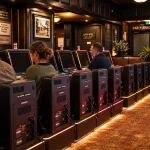
That matters in Australia. Real-money online casino games cannot lawfully be offered to people here, so I can’t point you to an online casino as a place to play. And figures about physical pokies in Victoria don’t fill that gap: they describe land-based gambling, not an online Mines game. Different thing entirely.
A report published by gamble.com.au put Victorian poker-machine losses at $2.6 billion over the year it covered, more than $44.7 million above the figure it gave for 2015. It also reported that the Epping Plaza Hotel, in Melbourne’s north, generated more than $21 million from 100 machines over the year covered. Those numbers are striking, but they are historical reporting about particular venues and machines—not a guide to finding Mines, and not evidence that a venue offers it.
There has also been political debate about limits on pokie betting. Senator Nick Xenophon and MP Andrew Wilkie proposed a $1 maximum bet on poker machines. That was a proposal, not a description of Mines or a rule you can assume applies to every game.
I used to see a familiar name and skip straight to the “where” part. That was backwards. First establish what the name refers to; then distinguish a physical pokie from an online casino game. A venue’s machine figures, a political proposal and a product label each answer different questions. None identifies a verified place to play Mines online.
Pokies can cause serious harm, particularly for people vulnerable to gambling problems. If you are considering gambling in person, be 18 or older and don’t treat it as income. The label is not evidence.
A confident explanation of a Mines strategy can sound convincing, especially when it comes with a provider name attached. I’ve learned not to treat confidence as proof. A recommendation about when to stop, how to choose tiles or how to manage a stake only means something if it matches the rules of the particular game being discussed.
That is not a coy way of holding back a clever trick. It is the difference between describing a documented game and making up a system that merely sounds plausible.
The same caution applies to Spribe. A page, advert or game listing that puts the name beside “Mines” does not, by itself, establish that Spribe made or operates a Mines game. I can’t confirm that connection. Check the game’s own information and the operator’s description before treating a provider label as settled.
Watch for language that turns a guess into a promise: “safe pattern,” “guaranteed method,” or “beat the game.” Those phrases are sales talk unless the claim can be checked against clear rules and evidence. Even then, a strategy claim is not a guarantee of a result. Neat wording, same old uncertainty.
I would also keep general gambling information separate from Mines advice. A percentage published for a provider’s slots, for instance, would not tell you how a Mines game works or what choices to make in it. Different products are not interchangeable just because they sit under the same casino label.
So if you come across a detailed plan, look for the exact game name, its rules and a clear explanation of what the proposed method can—and cannot—show. If those basics are missing, I would not risk money on the strength of the strategy claim. No magic pattern.
When I see Casino Guru placed beside Mines, I treat that pairing as a clue about what someone wants to find, not evidence that the two are connected. A name in a heading, snippet or discussion can make a link feel established before you’ve even opened the page. It isn’t.
The same goes for a page that appears to discuss a Mines game. Its existence would not, by itself, verify the game’s identity, its features, or who operates it. And Casino Guru appearing near the name would not prove that it reviewed the game or endorses an operator. Those are separate claims. They need separate support.
I’ve been caught by polished labels before. “Reviewed” sounds reassuring; what matters is what was actually examined and whether the page identifies the specific game and operator clearly. A familiar brand can draw your eye, but it cannot fill in details that the page does not provide.
So I’d read the wording narrowly. Is Casino Guru named as the publisher, merely mentioned, or shown beside the game in a search result? Does the page identify a particular Mines title, or is it using the word more generally? If those distinctions are blurry, don’t turn proximity into proof.
That caution cuts both ways: I’m not claiming there is no connection. I’m saying the name alone cannot establish one. Nor should it be mistaken for confirmation that a particular game or casino is available to Australians. A label is not a receipt.
I’d want a clear, direct statement before repeating a claim about a review, game or operator. If all you have is two names sitting together, keep the conclusion modest. Nothing more.
A progressive jackpot belongs to a different kind of game discussion from Mines. The word “progressive” describes how a jackpot can grow as people play linked machines or a network of pokies. It does not explain how a Mines game works, and it offers no route to a better Mines result. I would keep those ideas separate rather than letting a large jackpot figure make an unrelated game sound more predictable.
There are two broad arrangements. A standalone progressive is attached to a local machine or group of machines. A networked progressive links a larger pool, which can span many machines or, in some settings, an operator’s fleet. In either case, play contributes to the growing jackpot pool. That describes where the jackpot builds; it does not tell you that every bet qualifies to win it.
Standalone progressives are attached to a local machine or group, while networked progressives link a larger pool across many machines or an operator's fleet.
That last distinction is easy to miss. A jackpot displayed near a game can look like part of the ordinary prize, but eligibility may depend on specific conditions. Before you treat the displayed figure as relevant, check the contribution rate and the minimum bet required to qualify. Those details belong to the jackpot terms, not to a general idea of how pokies work.
A specialist review has described contribution rates and qualifying bet levels as details players should check, but such terms can vary and may change. The useful habit is to confirm the conditions for the particular game and jackpot rather than carry a figure from one machine to another. A minimum bet is not just a suggested stake: where it is a condition of jackpot eligibility, betting below it may mean the progressive prize is out of reach for that play.
Some games set a qualifying minimum; A$1.00 is one example, not a universal threshold. Do not assume that this example applies to another pokie, or that a larger bet automatically improves your chance in a way the rules do not state. Find the jackpot’s own rules and check what counts as an eligible bet.
I have seen how the headline number can distract from the small print. “Every spin builds the jackpot” sounds simple; the practical question is whether your specific bet contributes and whether it meets the qualifying conditions. If those details are hard to locate, the jackpot display alone cannot answer them. No shortcut there.
Contribution rate and minimum bet are separate checks. One tells you how play feeds the progressive pool; the other tells you what stake is needed for eligibility. Neither should be guessed from the size of the prize, the name of the game, or a description of another jackpot. If the rules are unclear, you cannot sensibly work out what the displayed amount means for your play.
The distinction between a local and networked jackpot matters too. A standalone progressive is tied to a local machine-level arrangement. A networked one draws on play across a broader set of connected machines. The wider pool may help explain why the displayed total differs from a local jackpot, but it does not establish that a particular game is connected to one. Check the terms for that specific jackpot.
People can land on a page about Mines while looking for casino games, then encounter jackpot language nearby. That does not make progressive-pokie information evidence about Mines. These jackpot details concern linked machines, contributions and eligibility conditions; they say nothing about Mines mechanics, outcomes or strategy. A pokie jackpot is not a Mines system in disguise.
It is also worth keeping the setting in view. Australia’s rules prohibit operators from providing real-money online casino games to people in the country. An explanation of how progressive jackpots work is not an invitation to seek out online casino play. For anyone considering gambling in a permitted setting, the practical checks remain the same: be at least eighteen, read the conditions, and do not treat a jackpot as income or a way to recover losses. Gambling can cause serious harm, particularly for vulnerable people.
So, if a progressive jackpot catches your eye, slow down and separate the visible prize from the eligibility rules. Identify whether it is standalone or networked, then verify its contribution rate and qualifying minimum bet. Treat A$1.00 only as an example of a possible minimum, not as a general rule. Those checks can clarify how that jackpot is structured; they cannot turn it into a Mines strategy or tell you what any individual play will produce.