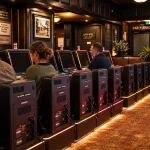
The guide distinguishes electronic and live formats and highlights rules, odds, bonus terms, and checks around deposits and withdrawals.

Electronic craps puts the game on a screen rather than around a live table. You interact with a digital interface, not a dealer and other players gathered in a room. That changes the feel: the experience is shaped by the software’s display and controls, so it is worth noticing what the game actually offers before treating it as the same thing as a live table.
I’m wary of labels such as “authentic” when they do not explain anything. In this case, electronic describes the format, not a promise that the screen recreates every part of being at a physical table. The interface may present a craps-style game, but it is still a digital product. The useful first check is whether you can follow what is on screen and understand the controls—not whether a casino calls it the best online craps casino.
That distinction matters when you compare electronic play with a live-dealer version. A live table brings a human dealer into the experience; an electronic game does not. If you are looking for online casino craps, start by identifying which format a particular game uses. The name alone may not tell you how it is presented.
Choosing an online craps casino in Australia calls for checking the available operator and payment information before you decide where to play. Use these notes as a starting point, and confirm that craps is available to you at the casino.
DragonSlots Casino
DragonSlots is listed with a Curacao Gaming Authority licence held by Jumpman Gaming Ltd. That licensing information is the main detail available to help you assess the operator.
Playfina Casino
Playfina is listed under a Curacao eGaming licence held by Hollycorn N.V. since 2017, and its minimum deposit is A$20–30 depending on the offer.
7Bit Casino
7Bit is listed as a Curacao casino operated by Dama N.V. The supplied information gives you its operator and licensing details, but no payment details.
Roby Casino
Roby Casino is listed under a Curacao eGaming licence held by Roby Games Ltd. This licensing detail is the available point of reference for you.
SpinsUp
SpinsUp is listed under a Curacao Gaming Control Board licence, OGL/2023/174/0082, held by Dama N.V. You can use those details as a starting point when assessing the operator.
Neospin
Neospin is listed under a Curacao Gaming Control Board licence, OGL/2023/176/0095, held by Hollycorn N.V. The supplied information identifies its licence and operator.
Ricky Casino
Ricky Casino lists crypto payouts in under an hour and PayID payouts in 1–3 business days. The minimum deposit is A$20, or A$30 to qualify for the bonus.
Kingmaker
Kingmaker lists crypto payouts at around 90 minutes and fiat payouts in 1–5 days. Its minimum deposit is A$30.
SkyCrown
SkyCrown is listed under a Tobique Gaming Commission licence. Its listed payout times are around 10–15 minutes for crypto and 1–5 days for fiat, with a minimum deposit of A$30.
House of Pokies
House of Pokies lists an international iGaming licence, but the source does not name the jurisdiction. PayID payouts are listed at 1–24 hours; the minimum deposit is A$30, or A$10 for PayID.
There is another distinction Aussie gamblers should keep in view: the legal position of the operator is not the same as the position of the person using a site. Australia has no domestically licensed real-money casino sites available to players. Under the Interactive Gambling Act 2001, a company must not provide real-money interactive casino games from within Australia to people here. The law does not make an individual Australian player a criminal merely for playing on a foreign-licensed site.
That is not a green light or a claim that every offshore service is lawful to offer. A foreign licence does not turn the provision of casino games to people in Australia into a locally licensed service. The legal distinction is about who is providing the service and who is playing. Easy to muddle. Important not to.
When I first started comparing casino games online, I gave too much weight to the label and too little to the actual format. “Craps” could mean a digital game or a live presentation, and those are not interchangeable experiences. Before getting drawn into a page’s claims about the best craps online casinos, check whether it clearly identifies the game as electronic. If it does not, you are left guessing about the basic product.
For electronic craps, the screen is the central part of the experience: it is where you see the game and make your selections. That can suit someone who wants a digital interface without a dealer-led presentation. It may not suit someone who wants the social atmosphere or visible human interaction of a live table. Neither description makes one version better for everyone. I’d rather know what I’m signing up for than rely on a glossy label.
So, when you come across an online craps casino, separate three questions: is the game electronic or live, what does the interface actually show, and what is the legal context for offering it to people in Australia? Those questions won’t tell you whether a game is enjoyable, but they can stop a format label or offshore licence from being mistaken for something it is not.
Live craps is presented through a dealer-led video stream rather than generated entirely on a digital table. That changes what you see and hear: a person is running the session, while the game is shown as it happens. The format can feel closer to watching a casino table than using electronic craps, where the interface and its on-screen presentation do more of the work.
That difference is about presentation, not a promise of a better game. A live camera does not tell you whether a particular table suits you, and a dealer’s presence does not make the terms around play disappear. I used to treat a more realistic-looking screen as a sign that the whole experience was somehow more straightforward. It isn’t. A polished stream can still sit alongside rules, restrictions and promotional conditions that deserve a separate read.
Attention: A polished live stream does not eliminate the rules, restrictions, and promotional conditions that require a separate read.
The pace may also feel different. With a dealer-led broadcast, you are following a session as it unfolds rather than interacting with a purely digital presentation. That can make the table easier to watch, but it can also mean waiting while the session proceeds. There is no need to assume that every live game offers the same interface or pace; those details depend on the specific product. What matters is deciding whether you want a human-led presentation, not mistaking it for a change to the underlying terms.
For Aussie gamblers, the practical distinction is worth keeping clear: electronic craps and live casino craps are different ways of presenting play, but neither label tells you what a promotion permits. If a bonus is involved, check how the operator treats live dealer games before you opt in or start wagering. “Live” sounds like a feature; the small print decides whether that play helps meet a promotion’s conditions.
Live-table wagering can count less toward bonus requirements than slots. Live dealer games often receive a contribution of 0–10% toward wagering requirements, while slots generally contribute fully. That gap can make a bonus take longer to clear through live play, or mean that the play contributes very little. The exact treatment depends on the offer, so read its terms rather than assuming all table games are counted alike.
I’ve learned not to look only at the headline figure on a promotion. The contribution rate, maximum bet rules and excluded games can matter just as much to whether bonus winnings remain eligible for withdrawal. If the terms are unclear, pause before accepting the offer. A bonus you cannot use as expected is not much of a bonus.
There is also a broader Australian-market point: real-money online casino games are prohibited services when provided to people physically located in Australia, and offshore sites do not come with the protections available through domestic regulators such as ACMA. Individual players are not criminalised for playing at foreign-licensed sites, but that is not the same as having local safeguards. The live-dealer format does not alter that distinction.
So, if you are comparing the feel of live and electronic play, focus on the presentation and the pace you prefer. If you are considering a promotion, treat its conditions as a separate decision. A dealer on screen may make a session feel more personal. The fine print remains the fine print.
If you’re learning how to play craps, resist the urge to copy a bet before you know what the screen is showing. I made that mistake with casino games more than once: I saw a busy table, assumed the labels would make sense as I went, and ended up trying to catch up while decisions were already being presented. Slower is better.
Start by watching a complete round without placing anything. Treat the display as a sequence of prompts, not as a set of instructions you already understand. Notice when the game indicates that a round is beginning, when it shows a result, and when it resets or presents another decision. Those visible transitions give you a basic map without requiring you to guess what a particular bet does.
When you approach casino craps, first check the game’s own help or rules panel. Read the names and explanations of the available choices before touching the betting controls. If a label is unfamiliar, pause there. A short description in the game is more useful than relying on a memory of how another casino game worked; similar-looking controls do not prove that the rules are the same.
Next, watch what the interface changes after each prompt. A decision area may open, close or update as the round progresses. Pay attention to which parts of the screen are active and whether the game is asking you to act or simply displaying information. Don’t treat every highlighted area as a recommendation. It is a cue to inspect, not a reason to click.
Then follow the result display through to the next screen. Rather than trying to work out the whole game at once, connect each prompt with the event that follows it. If you cannot explain that connection in plain words, watch another round before deciding what to do. No shame in that. Guessing is expensive.
To understand how to bet on craps, begin with the controls, not a strategy claim. Find where the game explains each selection, how it shows a chosen stake, and how you can review or remove a selection before confirming it. The exact options and mechanics depend on the game, so don’t assume that a control behaves the same way across every version.
If you’re playing online, use the pause between prompts to read. A digital display can move quickly, but you do not need to match its pace. Keep your attention on one thing at a time: what the game is asking, what you selected, and what the game reports afterward. If the screen does not make a step clear, return to the rules panel rather than filling in the gap from a video or a stranger’s confident explanation.
There is an important Australian context, too. The Interactive Gambling Act 2001 prohibits companies from providing real-money online casino games to people in Australia. It does not make an individual player’s use of a foreign-licensed site a criminal offence, but offshore services do not carry the protections available through domestic regulators such as ACMA. Knowing how a game works is separate from deciding whether to use a service.
When people talk about winning at craps, they often make it sound as if a trick can replace understanding the game. I’d be wary of that framing. First learn to read the prompts and explain your choices; don’t mistake a run of results for proof that you have found a reliable method.
For now, the useful goal is modest: watch, read, and be able to describe what the interface is showing before you act. That is learning the game, not chasing a result.
Free play and real-money play may look similar on a screen, but they serve different purposes. A free mode, where offered, is for trying the interface without staking cash. Real-money play puts your balance at risk. That difference matters more than the word “free” in a game label.
I’ve made the mistake of treating a practice session as a reliable preview of what playing for money will feel like. It can help you get used to controls or follow a round without pressure, but it does not make a later cash session risk-free. Nor should you assume a free version is available just because a casino offers a real-money game, or the reverse. Check the individual game page and the casino’s terms before relying on either.
Free mode is for testing the interface without staking cash, while real-money play puts your balance at risk.
If a free version is available, use it as a low-pressure way to explore the presentation. You can see what information the game puts on screen and whether you can follow it comfortably. That can be useful, especially if the interface is unfamiliar.
But practice is not a promise about future results. A run of outcomes in a free session does not establish what will happen next, and it cannot tell you that a particular real-money option is a better choice. I used to read too much into a short session. It felt like evidence. It wasn’t.
The same caution applies to claims about the “best odds in craps.” Odds are not a general stamp of quality that you can transfer from one game or option to another. Before putting money in, look for the game’s own information and read what it says about the available choices. If those details are not clear to you, pause rather than filling the gaps with assumptions.
There is another distinction that can trip you up: game odds and bonus wagering requirements are separate things.
Odds concern the game itself. A wagering requirement concerns a promotion’s conditions: it sets how many times the bonus amount must be bet before winnings can be withdrawn. It does not improve the game’s odds, and a large-sounding bonus does not tell you whether the underlying game is favourable.
I once saw a promotion and focused on the headline instead of what I would have to do to meet its conditions. That was backwards. If you accept a bonus, read its terms before playing and check whether your chosen game contributes toward the requirement. The amount of wagering required and the game’s odds answer different questions.
Keep the labels straight. “Free” describes whether you are staking your own cash; “odds” relate to the game; and “wagering requirement” describes a promotion’s withdrawal conditions. Mixing them together makes a decision look simpler than it is.
For anyone comparing free casino craps with real-money play, the sensible test is not whether a practice session went well. It is whether you understand what mode you are in, what information the game provides, and what conditions apply if you choose to play for cash. No shortcut there.
The phrase “bonus for craps” can sound simple: accept an offer, play at a table, then withdraw any winnings. The terms can make that much less straightforward. A promotion may set wagering requirements, assign different games different weights, and impose a maximum bet while the offer is active. Those conditions work together, so checking only the headline requirement leaves important gaps.
Wagering requirements describe how much qualifying play is needed before bonus-related winnings can be withdrawn. Game weighting determines how much a particular game contributes toward that requirement. A specialist review of casino bonus terms reports that table games typically contribute 10–20%. That is a broad category figure, not a promise about any particular craps game or offer. The terms for the promotion you are considering are what matter.
Legal Warning
Under the Interactive Gambling Act 2001, companies must not provide real-money interactive casino games from within Australia to people here.
That difference caught me out before: I treated “table games count” as if it meant they counted in full. It doesn’t necessarily. If a game contributes only part of each qualifying wager, progress toward clearing the requirement can be slower than you expect. And if a game is excluded altogether, play there may not advance the requirement at all. Check the listed contribution for the specific game rather than assuming all casino craps tables are treated alike.
Before accepting a craps bonus, read the full terms and conditions. Look for the wagering requirement, which games qualify, how each game is weighted, and the maximum bet allowed while wagering. Also check whether the offer has a deadline or other restrictions; don’t assume that the headline description covers every condition.
The maximum bet rule deserves particular attention. A bet above the permitted limit while a bonus is active can put the bonus winnings at risk. The issue is not whether a wager seems modest to you; it is whether it stays within the promotion’s stated cap. If the cap or its application is unclear, don’t guess. Ask the operator to clarify before you play.
The same care applies if you switch between formats. An electronic game, a live table, or a bubble-craps title may not receive the same weighting—or may not qualify under the offer at all. The name of the format does not settle the question. Find the game in the terms, or get a clear answer before placing bonus-funded bets.
Craps rules describe how a game works; bonus terms describe the conditions attached to promotional funds and winnings. They are separate things. A rules page cannot tell you whether a particular title contributes toward wagering, and a bonus page cannot substitute for understanding a game before you play it.
I now treat an offer as a set of conditions to verify, not extra money I can count on. If I cannot tell how a table game is weighted or what the maximum bet means in practice, I leave the offer alone until that is clear. Once you accept a promotion, withdrawing before its wagering conditions are complete may be blocked; breaking its rules can also affect bonus winnings.
Read the terms before you opt in, and keep a copy of the relevant conditions. Check your progress in the account as you go, and don’t raise your stake to chase a requirement. A bonus can change the cost and constraints of play; it does not make the game a better deal by itself. Small print matters.
A craps table layout is meant to show where a player can place different wagers and what each area represents. It is a map, not a strategy in itself. When I first looked at one, I treated the busy design as if it were self-explanatory. It wasn’t. Labels and help text deserve a slower read than the graphics suggest.
The exact presentation can vary between games, so don’t assume that a familiar-looking casino craps table layout guarantees identical options or explanations. Before choosing anything, open the game’s information panel and check how it describes the available choices. If a label is unclear, pause rather than relying on a tutorial made for a different version.
That small habit helps separate learning the interface from learning a strategy. A craps tutorial may explain where choices appear on the screen, but that alone doesn’t establish what a wager does or whether it suits you. Treat the in-game explanation as the first reference, and be wary of advice that skips straight from a colourful diagram to a confident recommendation.
The phrase “best strategy” is doing a lot of work in gambling content. Sometimes it means a method for organising decisions; sometimes it’s dressed up to sound like a way to beat the game. Those are not the same claim. A clear explanation should tell you what it recommends, what assumptions it makes, and what it cannot promise.
I’m especially cautious when a casino craps strategy is sold as a system that removes risk, guarantees a result, or works every time. Confident wording is not evidence. Nor is a long list of steps: complexity can make advice look tested when it has not shown why it should be trusted.
A better test is to ask whether the explanation is specific enough to check. Does it define its terms? Does it distinguish a personal preference from a demonstrated advantage? Does it acknowledge uncertainty? If it relies on special rules or table features, confirm that those details match the game in front of you. If the claim stays vague when you look for the reasoning, I wouldn’t stake money on it.
The layout can help you navigate choices, but it cannot tell you that a particular approach is sound. And a diagram that looks familiar does not make advice transferable from one game to another. Keep those jobs separate: use the layout to understand the interface, and judge strategy claims by their reasoning rather than their packaging.
If you’re still learning, take the time to read the game’s own descriptions before making a decision. I’ve found that a flashy “winning system” is much easier to trust when I haven’t checked what it actually says. Slow down first. That’s the useful bit.
Craps belongs to the casino table-game category, but that label alone tells you very little about a particular online version. It does not confirm who made the game, whether it is electronic or hosted by a live dealer, or what options and features you will see. I’d treat a title and its description as the start of a check, not proof that two games work alike.
That distinction matters when you’re looking at casino craps games. The name may point to the same broad game, while the actual presentation and available choices can differ between products. Without reliable details for a specific title, claims about its rules, table options, or how it compares with another version are guesswork. I’ve seen enough confident casino copy to know that “authentic” is a word worth checking.
So what can you take from the category? Only the broad point: craps is presented as a casino game, and an online version may be offered as a table-game product. That doesn’t establish the rules of a particular game or tell you what the screen will show. If you want to know those things, look for clear, title-specific information before treating a general description as a promise.
Under the Interactive Gambling Act 2001, providing real-money online casino games to people in Australia is prohibited. While individual players are not criminalised for using foreign-licensed sites, these offshore platforms do not have the protections of domestic regulators like ACMA.
There is also an Australian legal distinction worth keeping straight. Under the Interactive Gambling Act 2001, companies must not provide real-money online casino games to people in Australia. Individual Australian residents are not criminalised simply for playing at a foreign-licensed site, but that does not make offshore casino services locally regulated. Protections available through the Australian Communications and Media Authority do not extend to offshore platforms. Different sides of the same issue.
That context is more useful than a broad claim that a site is “safe” or a game is “approved.” A foreign licence is not the same as Australian authorisation, and a game’s casino label does not settle questions about its features or protections. Keep the category separate from what a specific product can actually demonstrate.
I wouldn’t infer a casino game’s rules from its name, or assume that every version offers the same experience. Start with precise information about the particular title, and be wary when the description promises more than it explains. No grand claims needed. Just check what’s actually stated.
Before putting money into an online casino, separate the payment question from the legal one. In Australia, the Interactive Gambling Act 2001 prohibits operators from providing real-money online casino games to people physically in the country. It does not make an individual player’s decision to use a foreign-licensed site a criminal offence, but offshore services do not come with the protections available through domestic regulators such as ACMA. There are no domestically licensed real-money casino sites for Aussie gamblers.
Payment menus can include cards, e-wallets and cryptocurrency. That describes the categories an operator might list; it is not a recommendation to use any of them. Online gambling services must not accept credit-card payments, so check what a payment option actually is before proceeding. Neosurf is a deposit-only voucher: it cannot be used to withdraw funds.
I used to treat a visible payment logo as proof that the whole process would be straightforward. It isn’t. A deposit method and a withdrawal method may not be interchangeable, and the payment options offered can vary by operator. Read the cashier information and the relevant terms before sending funds. If the details are unclear, don’t guess.
Account verification deserves the same attention. Have your identity details ready and complete the operator’s checks before requesting your first withdrawal; identity verification is required before that first withdrawal can be processed. A specialist review also reports that casinos may request government-issued identification and proof of address when withdrawals exceed their stated thresholds. The threshold and document process can differ, so check the operator’s own requirements rather than assuming what you uploaded at registration will be enough.
That is account readiness, not a promise about when money will arrive. Keep your account information accurate, use payment methods in your own name, and make sure you understand what documents may be requested. If you are considering a casino craps game for real money, remember that no payment method changes the legal position of the operator or gives you the safeguards of an Australian-licensed casino.
Small print first.
My most useful craps tip has nothing to do with a bet: decide what you will do with a withdrawal before you request one. A pending payment can become an excuse to keep playing. Some specialist reviews report that casinos may hold a withdrawal request for a period ranging from zero to twenty-four hours, with a cancellation option during that time. That is not a promise about every operator or account. If cancellation is available, the money may be put back into play. I would treat the request as a commitment, not as a temporary pause.
Withdrawal Preparation
Account Verification
Submit identity documents and proof of address through the designated channel to avoid delays.
Request Commitment
Treat your withdrawal request as a commitment rather than a temporary pause to avoid the temptation to play again.
Condition Check
Verify that all promotion wagering requirements are completed before requesting a payout.
The second practical step is to get your account ready before you need a payout. A specialist review identifies incomplete account verification as a frequent cause of withdrawal delays. Casinos may ask for identity documents and proof of address, and they may need to check them before processing a first withdrawal. Submit what is requested through the account’s designated channel and make sure the details match. Fixing a mismatch after a request is already pending is a lousy time to discover it.
I used to think a withdrawal delay meant something had gone wrong with the payment itself. Sometimes the hold-up is further back: the casino has not cleared the account checks, or the request is still in its own pending stage. Keep the confirmation and any messages, then check the account status and the operator’s written terms before taking another step. Don’t assume a displayed processing estimate includes every stage.
Before depositing, read the withdrawal conditions as carefully as the deposit options. Check whether an active promotion affects access to your balance and whether its requirements must be completed first. If you accept an offer without understanding its conditions, a later withdrawal request may be declined or the bonus and related winnings may be forfeited. I have made that mistake. It is avoidable.
For anyone comparing online casinos that advertise craps, a flashy table or a “fast payout” label tells you little about how your own request will be handled. Look for clear terms on verification, pending requests, cancellation and promotion restrictions. If those details are vague, pause rather than depositing to find out. This is not a winning system; it is basic damage control.
Keep a record of your request and avoid cancelling it just because the money is not instant. If you do choose to cancel, understand that you may be returning the balance to play. A boring decision. Often the useful one.
The name “crapless craps” sounds like a clear promise about how the game works. It isn’t a rulebook. I wouldn’t infer from the label alone what happens during a round, which bets are available, or how the variant differs from standard craps. Those details need to be stated by the game provider, not guessed from a familiar-sounding name.
That matters if you’re comparing casino craps titles. A game’s label does not establish that it is available to you, that it uses a particular layout, or that its rules match another game carrying the same description. Nor does the word “crapless” tell you anything reliable about its odds or whether a particular bet is offered. I’ve seen enough marketing language to know that a catchy name can do a lot of work while telling you very little.
So treat the variant as a separate game until its rules are clear. Read the in-game help and pay attention to the full rules before staking money. If those explanations are incomplete or confusing, don’t fill the gaps with assumptions based on standard craps. That’s not being fussy. It’s basic due diligence.
There is also an Australian legal distinction worth keeping straight. Under the Interactive Gambling Act 2001, providing real-money online casino games to people in Australia is prohibited. Individual Australian residents are not criminalised simply for playing on a foreign-licensed site, but domestic regulator protections do not extend to offshore platforms. A licence elsewhere does not make an offshore casino a locally regulated service.
I can’t responsibly tell you that a particular crapless game is available to Aussie punters, or describe its mechanics as though they were confirmed. If you come across the term, ask what the actual rules say rather than relying on the title. If the rules aren’t presented clearly, walk away from the claim—not because the variant must be bad, but because you shouldn’t have to guess what you’re playing.
The label is not enough.
Yes, Australian players are not criminalised for playing at offshore casinos, but there are no domestically licensed real-money casino sites available to them. The law prohibits companies from providing real-money interactive casino games to Australians from within Australia, and offshore platforms do not offer the protections of domestic regulators such as ACMA.
It depends on the payment method and whether your account is verified. Tested bank transfers averaged 3.2 business days; Bitcoin Cash withdrawals took under four hours, while PayID arrives almost immediately after the operator sends it. Casino approval and any withdrawal hold can add time.
Crypto can be the fastest option: Bitcoin Cash withdrawals took under four hours in testing, and blockchain confirmation usually arrives within an hour after the casino releases the payment. Bank transfers averaged 3.2 business days, while credit-card refunds can take days after approval and may be delayed further by the bank.
Having your account verified can help avoid delays; casinos commonly request government ID and proof of address for withdrawals above certain thresholds. Some casinos also hold requests for 0–24 hours, and processing time varies by method—from almost immediate PayID transfers after sending to an average of 3.2 business days for bank transfers.