The term can describe a physical pokies venue, while online offers and casino sites raise different questions about legitimacy and regulation.
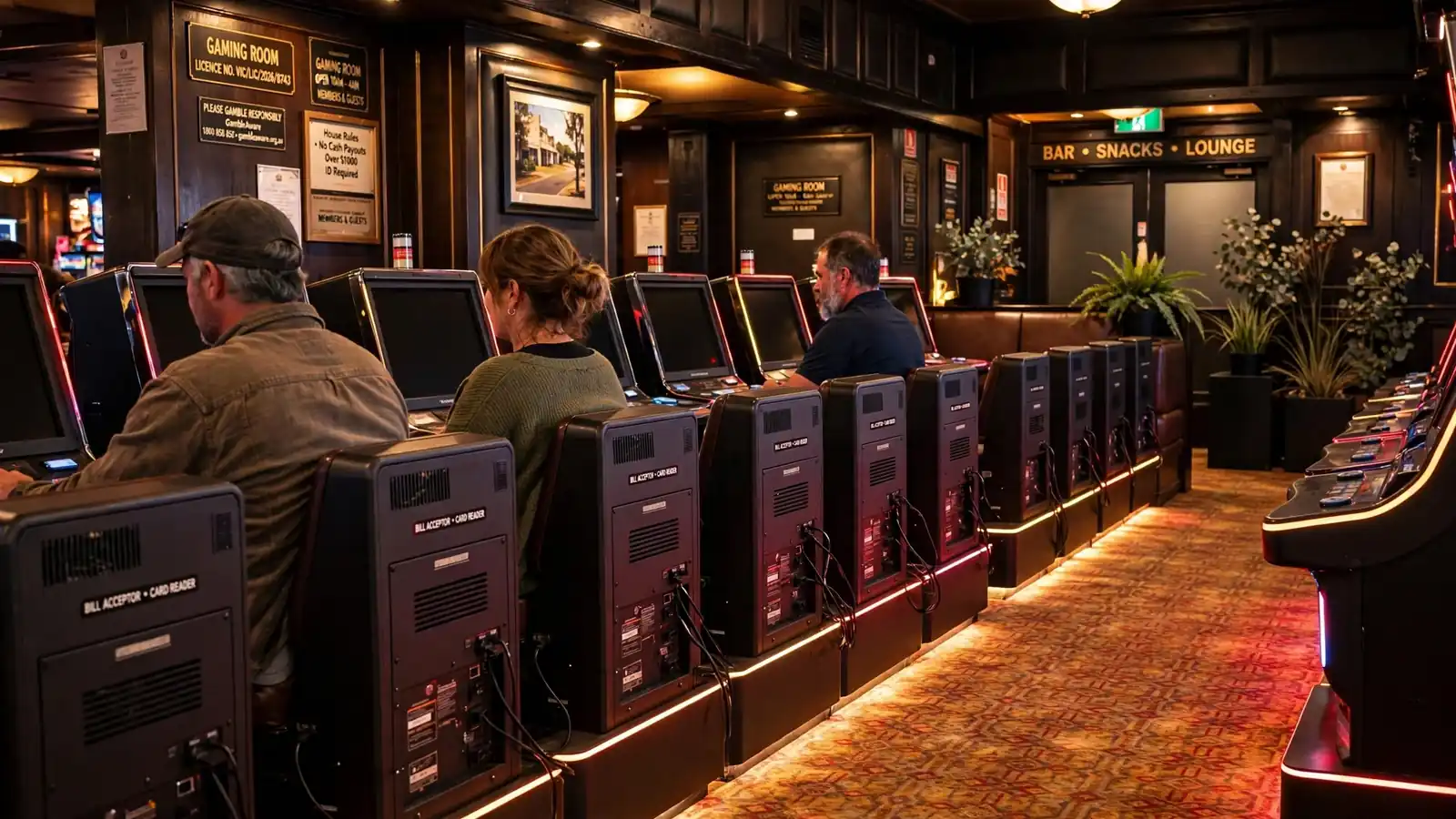
When I first came across “pokies parlour,” I pictured a small room devoted to machines, maybe with a separate sign over the door. The phrase can give that impression, but in Australia it is better understood as an informal way of describing a physical place where people play pokies, not as the name of a particular kind of online service. A casino is a real venue: a building with an operator, a location and rules set under the law of the state or territory where it stands.
That distinction matters because the words can be used loosely. Someone might call a casino a parlour, or use “pokie parlour” for a gaming area inside a larger venue. The label by itself does not tell you whether you are looking at a full-scale casino, another kind of gaming venue, or simply language on a screen. I used to treat a familiar-sounding label as if it told me more than it did. It doesn’t.
Choosing a pokies site is easier when you can see its stated licensing and payment details before you decide. Use this list as a starting point, and check the terms that apply to you.
DragonSlots Casino
DragonSlots Casino is listed with a Curacao Gaming Authority license under Jumpman Gaming Ltd. That licensing detail is the main concrete point available for your reference.
Playfina Casino
Playfina Casino is listed as licensed by Curacao eGaming, with Hollycorn N.V. as the operator since 2017. Its minimum deposit is A$20–30, depending on the offer.
7Bit Casino
7Bit Casino is listed as operating under a Curacao license through Dama N.V. The supplied information does not specify payment or deposit details.
Roby Casino
Roby Casino is listed with a Curacao eGaming license under Roby Games Ltd. The licensing information is the main stated detail to consider.
SpinsUp
SpinsUp is listed with a Curacao Gaming Control Board OGL, reference OGL/2023/174/0082, under Dama N.V. This gives you a specific license reference to check.
Neospin
Neospin is listed with a Curacao Gaming Control Board OGL, reference OGL/2023/176/0095, under Hollycorn N.V. The supplied details focus on its licensing.
Ricky Casino
Ricky Casino lists crypto payouts in under 1 hour and PayID payouts in 1–3 business days. The minimum deposit is A$20, or A$30 to qualify for the bonus.
Kingmaker
Kingmaker lists crypto payouts at around 90 minutes and fiat payouts in 1–5 days. Its minimum deposit is A$30.
SkyCrown
SkyCrown is listed with a Tobique Gaming Commission license. Its stated payout speeds are around 10–15 minutes for crypto and 1–5 days for fiat, with a A$30 minimum deposit.
House of Pokies
House of Pokies lists PayID payouts in 1–24 hours and a A$30 minimum deposit, with PayID deposits from A$10. Its source describes an international iGaming licence but does not name the jurisdiction.
Australian casinos are regulated by the state or territory in which each property operates. The relevant jurisdiction issues the licence for that property; there is no single national casino licence that turns every venue using the word “casino” into the same thing. So if you are trying to understand a physical casino, start with the place itself and the jurisdiction responsible for it.
That local link is part of what makes a venue different from a website carrying casino-style language. A physical property has an identifiable location and operates under a licence issued by its local jurisdiction. The word “parlour,” whether it appears in a conversation or in a venue description, does not replace those details or establish a separate licensing category.
A specialist review has described Australia as having more than 20 full-scale casinos across all eight states. Treat that as a reported snapshot, rather than a permanent count: venues and the market around them can change. The useful point for a reader is not to memorise a total, but to recognise that Australian casinos are physical properties operating within state and territory systems.
The minimum age for casino entry is 18 across Australia. That is a national baseline for entering a casino, not a clue about what a website means when it labels itself a parlour. Major casinos also require valid photo identification for entry. If you are visiting, bring ID and expect the venue to check it; don’t assume that looking old enough will be enough.
I learned to separate the practical question from the promotional wording. “Walk in and play” sounds simple, but entry is still governed by venue rules and age requirements. The same goes for any description that makes a casino sound like an informal room with no formal boundaries. It is still a regulated property.
All major Australian casinos operate 24 hours a day. That describes the opening pattern of physical casino venues; it does not mean that every service using casino language is a venue, or that a site operating around the clock has the status of one. A website can borrow the atmosphere of a casino without being a casino building.
This is where the phrase can get slippery. “Pokies parlour” sounds concrete, and a page might pair it with casino imagery, but those words alone do not establish a real address, a local operator or a venue licence. If you mean a place you can physically visit, look for information tied to the property: its location, the jurisdiction that regulates it and the entry conditions. Those details belong to an actual venue, not just a label.
I also wouldn’t assume that every place called a gaming venue offers the same setting or operates under identical rules. The casino industry is regulated locally, so the relevant details depend on the property and the jurisdiction. Broad wording can flatten those differences. It’s worth keeping the distinction clear.
For me, the simplest test is a plain one: am I reading about a building, or about a service on a screen? A physical casino has a local jurisdiction, a licence, an entry age and operating hours. “Parlour” may be casual wording for the gaming area or the venue, but it doesn’t change what the place is. The label is not the venue.
“No deposit” sounds like a gift: create an account, claim a balance, and start playing without putting your own money in first. I understand the appeal. I’ve clicked on offers like that because the wording made the risk seem small. But the label tells you about a promotion, not whether the service is lawful in Australia.
That distinction matters. Under the Interactive Gambling Act 2001, operators cannot provide real-money online casino games, including slots, poker and table games, to people physically located in Australia. Calling an offer a sign-up bonus, making it available before a deposit, or describing it as free does not turn an online casino service into an Australian-licensed one. The offer is not a licence.
A sign-up offer is a claim made by a website about what it will credit to an account or what it says a new customer can access. It may be framed as a “no-deposit bonus” or as a bonus for joining without paying first. Those phrases can sound precise, but they don’t establish who is behind the service, what rules apply to it, or whether it can lawfully provide online casino games to someone in Australia.
I used to treat a bonus with detailed terms as if detail itself were reassurance. It isn’t. A page can spell out how an offer is presented while leaving the important question unanswered: what kind of service is this, and is it allowed to offer that service here? The promotional wording cannot answer that.
Nor does the absence of an upfront payment make the underlying activity something else. If a site is offering online casino play for real money, the fact that an account can be opened before money is deposited does not change the legal status of the service. “No deposit” describes the pitch. It does not describe an Australian authorisation.
That’s the catch.
It is tempting to regard a site that loads, accepts registration details or lets you into an account as a site that must be legitimate. I’ve made that leap myself. It feels like a practical test: if the page works, surely the service is meant to be available. But access only tells you that the page is reachable at that moment. It does not establish that the operator is licensed in Australia or permitted to provide online casino games to Australian customers.
The same goes for a replacement web address. A specialist review describes domains changing over time as blocking affects which addresses resolve through Australian internet service providers. That is a description of how access can shift, not evidence that a new address has been approved or that the service has become lawful. A changed web address is still just a changed web address.
I wouldn’t read a fresh link as a clean slate. If one address stops working and another appears, the move does not settle the status of the service. It does not matter whether the new page looks familiar, carries over an account login or repeats the same bonus language. Those things may connect the pages in a user’s experience, but they do not amount to Australian licensing.
Legal Risk
Under the Interactive Gambling Act 2001, operators cannot provide real-money online casino games to people physically located in Australia, regardless of whether a sign-up offer is "no-deposit."
When I see a “no-deposit sign-up bonus” claim now, I separate the wording from the decision it is trying to encourage. First, it invites you to think about joining and playing. Then it can make that step feel harmless because no payment is supposedly needed at the outset. Neither part supplies proof that the service is lawful for Australians.
Don’t let the word “bonus” do the work of evidence. A headline can be confident, a registration form can function, and a domain can change; none of those facts makes online real-money casino games lawful to provide in Australia. If an offer is built around access to those games, the central issue is the service itself, not whether the first step is described as free.
I’ve learned not to treat a low-friction sign-up as a safety signal. It can make a decision feel smaller than it is. Pause before sharing personal details or opening an account, and don’t mistake a promotional promise for proof of legal status. The wording may be designed to get you through the door. It cannot make the door an Australian-licensed casino.
When I first looked into online casino-style play from Australia, I treated a page loading as a sign that the service was meant for people here. That was a poor shortcut. A website appearing on your screen tells you about access, not whether its service is lawful in Australia.
The distinction matters because the Interactive Gambling Act 2001 prohibits operators from providing real-money online casino games to people physically in Australia. That covers casino-style games such as slots, poker and table games. The Australian Communications and Media Authority, or ACMA, is the federal regulator responsible for enforcing that law and monitoring compliance with federal interactive gambling rules.
ACMA does not simply label a website and make it disappear from every device. It can ask Australian internet service providers to block access to a site that provides prohibited interactive gambling services, or advertises them to people in Australia. If a block is applied, a domain may stop resolving through a provider. That is an enforcement measure—not a verdict you can reverse by finding another address.
The scale is substantial. After enforcement actions began in November 2019, ACMA’s blocking work had covered more than 1,455 illegal gambling and affiliate websites. That figure describes websites blocked, not a list of services endorsed or made safe for players. It also does not mean every blocked site was an online casino; the category includes illegal gambling and affiliate websites.
ACMA has also reported withdrawals from the Australian market since it began enforcing the rules in 2017. Published accounts differ on the total: one places the number above 210 services, while another reports more than 190. Those are two reported counts, not a single figure to add together. The takeaway is the enforcement activity, not a precise tally.
I used to read a changing web address as a technical nuisance and move on. It can be more important than that. Blocking can affect which domains Australian providers allow to resolve, and alternate addresses may appear later. A new address does not change the underlying service or establish that it is authorised to offer online casino games here. Nor does a page accepting account traffic settle that question. A working link is just a working link.
ACMA Enforcement
Since November 2019, the ACMA has blocked more than 1,455 illegal gambling and affiliate websites and reported the withdrawal of between 190 and 210 services from the Australian market.
For someone searching for a way to play online, ACMA’s role is easy to misread. It is not a directory of online casinos, and a site’s absence from a block notice is not proof of approval. Its relevant powers include investigating and acting where operators provide or advertise prohibited interactive gambling services, and requesting that providers block access.
That makes enforcement information useful as a warning signal, but not as a complete status check. A blocked domain indicates action against access to that address; an unblocked one does not establish that the operator may legally serve Australian customers. The law applies to the service being provided, not merely to the spelling of the web address.
So when an online casino page appears to open, I no longer treat that as the answer. ACMA’s blocking record shows that Australian authorities do act against prohibited services, while the law explains why online casino play is not a lawful offering for people physically in Australia. The practical point is simple: access and legality are different things. A new address changes the first, not the second.
“Free spins” and “free chips” sound like small, harmless extras. I used to read those words as a sign that a site had something concrete to offer. They tell you far less than that. A phrase on a page can describe a promotion, attract attention, or simply sit beside a sign-up button; it does not tell you whether the service is authorised to provide online casino gambling in Australia.
That distinction matters because Australian law does not permit operators to offer real-money online casino games to people located in the country. Casino-style games provided online, including slots and table games, fall within the prohibited services. So a free-play claim is not a shortcut to a lawful Australian casino, even if the page looks polished or uses familiar local language.
The wording itself is slippery. “Free spins” may sound as if a player can try a game without paying, while “free chips” can suggest a no-cost balance for casino-style play. But the label alone explains none of the conditions attached to the offer, what a user would actually be able to do, or whether the promotion is genuine. I’ve learned not to fill those gaps with the interpretation I hope is true. A catchy label is still just a claim.
Nor does the word “free” settle what happens next. It might sit beside a request to create an account or direct you through a sequence of pages. That does not make the offer safe, available, or legally valid for someone in Australia. I would not treat a button, a welcome message, or a balance displayed on screen as proof of any of those things.
The same goes for a page that loads without trouble. A website being accessible, taking account traffic, or appearing at a different web address does not establish that it is an Australian-licensed online casino. Those details describe what you can see or where a page is reached from—not the service’s standing under Australian law. Easy to confuse. Not the same thing.
When you come across a “free” claim, keep the question narrow: what is the page actually claiming, and what does that wording prove? Usually, only that the page is using promotional language. It cannot certify an Australian licence, turn a prohibited service into a permitted one, or confirm that the advertised play is genuinely free of conditions.
I know the pull of a small offer. It feels like a way to test something without much at stake. But I’ve made enough decisions based on the first bright phrase on a screen to know that the phrase is often the least useful part. Read it as advertising, not as evidence. A free-play label cannot do the job of establishing whether an online casino service is lawful in Australia.
I used to treat a confident review as if someone had done the checking for me. A tidy score, a few polished photos and words like “premium” made the place—or the service—feel settled. That was a lazy shortcut. When you read a review of a pokies parlour, first work out what it is actually reviewing: a physical venue, or a website using similar casino language.
A useful venue review gives you things you can pin down. Look for the casino’s name and location, a clear description of the property, and practical details about visiting. Does the writer explain what they saw and when, or does the text stay vague enough to fit any venue? “Great atmosphere” tells you little on its own. It’s decoration.
Opening hours offer a simple reality check. All major Australian casinos operate around the clock. So if a review presents one of these venues as having ordinary closing hours, or gives no sense of whether it is describing a particular property, pause and check the wording. That detail does not tell you everything about a visit, but it helps distinguish a real-world account from generic promotional copy.
I also look for a clear separation between observation and opinion. “The review describes the building as busy” is different from a reviewer claiming that a visit will be enjoyable for everyone. One is an account; the other is a promise dressed up as a verdict. A strong rating does not make the second claim more reliable.
Photos and specific descriptions can help, but they are not proof by themselves. Ask whether the text connects them to the venue being reviewed. Does it describe identifiable parts of the property, or could the same caption sit under pictures from somewhere else? If the writer provides no context, treat the images as illustrations, not evidence.
Most importantly, keep the subject straight. A review of a physical casino can tell you about that venue and the reviewer’s account of it. It does not, just by appearing beside a website link, establish what that website is or whether it is authorised to provide an online service. Those are separate claims. I’ve made the mistake of letting a detailed-looking page blur the two. Don’t let a venue description do work it was never equipped to do.
When comparing pokies parlour reviews, read beyond the star score. Check whether the same practical details recur consistently, whether the writer distinguishes personal impressions from verifiable information, and whether the page explains what it means by “review.” A short, concrete account can be more useful than a long page full of applause.
The word “verified” deserves the same scrutiny as “best.” Ask what was verified: a physical address, the accuracy of a venue description, or something else? If the review does not say, the label is just a label. Keep the conclusion modest: a review may help you understand a venue, but it cannot automatically validate every service mentioned alongside it.
That’s the useful distinction. A venue review describes a place. Nothing more.
Australia’s gambling map is spread across cities and jurisdictions; it isn’t one neat strip of casino venues. A specialist gambling-directory review counts facilities in 147 Australian cities. Treat that as the directory’s snapshot, not a permanent census: venues and listings can change, and the count covers gambling locations rather than casinos alone.
Sydney stands out in the same review, which identifies it as the country’s largest gambling city and counts 11 gambling facilities there. That gives a sense of concentration, but it doesn’t mean every facility is a casino or that the city’s venues share one layout. I’ve learned to read a location count for what it says, not stretch it into a recommendation. Numbers need context.
The locations are distributed across Australia, and the details can be quite specific. Jupiters Gold Coast Casino & Hotel is on Broadbeach Island, while Country Club Casino is listed on Country Club Avenue in Prospect, in Meander Valley. Those examples alone show why a label such as “parlour” doesn’t tell you much about the building, its surroundings or what kind of facility you’re looking at.
For the Northern Territory, a specialist venue listing reports three casinos across three cities. That is a listing-based snapshot, not a guarantee that every directory will describe the territory in the same way or remain current. In that same listing, Alice Springs is the city with the most casinos in the territory: one. The wording sounds odd because it is a comparison across the cities in that listing; it does not mean Alice Springs has a cluster of casinos.
One named location makes the geography concrete: Lasseters Casino is at 93 Barrett Drive, Alice Springs, NT 0870. It is a fixed address, unlike a broad phrase such as “Northern Territory casino,” which can leave you unsure which city or venue is meant. If you’re planning around a physical place, the city and street address are the useful details.
A national tally of gambling facilities and a count of casinos answer different questions. The first can include a wider range of places; the second refers to casinos. Keep those categories separate when comparing cities or trying to understand how far a venue might be from you. Otherwise, a big number can create the impression of a casino nearby when it may describe something else.
I’d also check the jurisdiction attached to a venue rather than assume that a name used across Australia points to one national operation. Casino properties operate under licences issued by their local jurisdictions, so a location is part of the picture. A city count is only a starting point.
The practical takeaway is simple: look for the actual city and venue, then treat directory totals as a dated snapshot rather than a promise about what you’ll find on arrival. The map is broad. The details matter.
Identified as the country's largest gambling city with 11 gambling facilities.
Reports indicate three casinos across three cities, with Alice Springs having one.
Includes locations like Jupiters Gold Coast Casino & Hotel and Lasseters Casino in Alice Springs.
A bonus can make a page look polished and official. I used to treat a confident headline as a sign that someone had checked the service behind it. That was the mistake: an offer is a claim made by a website, not evidence that the operator holds an Australian casino licence.
That distinction matters here. Australian casino properties are licensed by their state or territory, but real-money online casino games are prohibited for operators serving people in Australia under the Interactive Gambling Act 2001. A promotion does not change that legal position. Nor does a page’s appearance, its account features or the fact that it loads on your device tell you that the service is licensed locally.
A shiny label is still a label.
I’d also be careful about treating a working web address as proof. ACMA can ask Australian internet service providers to block access to sites providing prohibited interactive gambling services or advertising them. Blocking may affect which domain resolves for a person using an Australian provider, and a service may later appear at another address. The address changing is not a fresh licence or a clean bill of health.
A specialist review reports that ACMA has taken blocking action against illegal gambling services, including alternate domains associated with Fair Go. The useful point is not to infer anything from one name or URL. It is that blocking and domain changes can be part of the same landscape; neither an inaccessible page nor a newly working one settles the operator’s status.
When I see a “pokies parlour bonus” or similar promise, I now separate the words on the page from the question that matters: what kind of service is this, and is it legally permitted to provide that activity to people in Australia? A bonus headline cannot answer that. If a site presents itself as a physical venue, look for practical venue details; if it is offering online casino play, don’t confuse its promotional language with local authorisation.
The same goes for “new address” notices, copied promotional pages and claims that a site is back. Those details can explain why a link behaves differently, but they do not establish that the service is lawful. I learned to stop letting a familiar logo or a tempting offer do the checking for me. The promotion may be easy to read. The regulatory question takes more care.
“VIP” sounds like a promise of a separate room, personal service or special access. I’ve learned not to fill in those blanks myself. A label can catch your eye; it does not tell you what a particular venue provides.
When I see a VIP parlour casino description, I treat “VIP” as a claim to check, not a feature I can assume. Look for a plain explanation of what the label means at that specific property. Does the venue describe a membership arrangement, or is “VIP” simply part of a headline? If the details are vague, the word has done its job as advertising and little else.
There is a more solid distinction to keep in mind. Australian casino properties operate under licences issued by the state or territory where each property is located. That jurisdictional licence is about the casino’s regulatory status; it does not, by itself, confirm that a VIP area, membership tier or particular benefit exists.
I used to read polished labels as if they were descriptions. They aren’t. The useful details are the ones that say what the venue actually offers, where it applies and what conditions go with it. If those particulars are absent, don’t turn the label into a promise in your head.
“Exclusive” is another word that can sound more concrete than it is. The same goes for “premium” or “elite”. None tells you whether access is available, what it involves, or whether there is a dedicated facility. Those points need to be stated by the venue, not inferred from a name.
So, separate the two questions: is this a casino property operating under its local jurisdiction’s licence, and what does its VIP wording specifically mean? One is a regulatory matter; the other is a claim about the venue. Keep them apart. Less guesswork.
The word “parlour” can make a gaming venue sound like a small room with a predictable setup. I used to take labels like that too literally. A name does not tell you how many machines a particular casino has, or what you will find on its floor.
Across Australia, 3,308 gaming machines are endorsed on venue licences and installed in casinos. That gives a national snapshot, not a guide to any one property. The total does not mean each casino has the same number, and it should not be divided up as if the machines were spread evenly. Venue licences and installed equipment are the basis of the figure; it is not a promise about what is available at a specific location.
That distinction matters when you are trying to understand what “parlour pokies” refers to. People may use the phrase loosely for machine-based gambling in a casino, but the wording does not identify a separate type of licensed venue. Nor does the national count confirm that every casino has an identical floor plan or machine selection. Those details belong to the individual venue, not to the label.
I’ve learned to be wary of turning a large number into a reason to visit. A count tells you about scale, not quality, suitability, or what a session will cost you. It also says nothing about whether a particular machine is operating when you arrive.
So treat the figure as context: Australia’s casinos have thousands of licensed and installed gaming machines in total. It is a useful measure of the industry’s footprint, but a poor shortcut for judging one venue. Labels are not layouts.
“Real money” can describe two very different things. At a physical casino, you’re entering a venue and gambling there in person. Casino entry is restricted to people aged 18 or over across Australia. An online page that takes account activity is a different matter; it doesn’t become a physical casino just because it uses familiar parlour language.
I used to treat a site that opened normally as a reassuring sign. That was a bad shortcut. A page loading, letting you sign in, or accepting account traffic tells you about access—not whether the service is authorised under Australian law. The same goes for a different web address: an alternate domain does not turn an online casino service into an Australian-licensed one.
There’s a more basic distinction here. Australian law prohibits operators from providing real-money online casino-style gambling to people located in Australia. So a website presenting itself as a place to play for cash is not equivalent to walking into a licensed, physical casino. The wording on the page cannot erase that difference.
I’d keep the labels separate when you’re deciding what you’re looking at: a venue is a place you enter; a website is an online service. “Pokies parlour” may sound like a local gaming room, but online branding doesn’t establish that a service is a lawful Australian casino. Nor does a working login, a balance shown on screen, or a new address settle its status.
That’s the line I wish I’d drawn sooner. Real money, different rules.